The AEO Iceberg: Answer Engine Optimization for Life Sciences 2026
BY:
Christy Hui
19 Min Read
Updated 09/02/2026
Table of Contents
TL;DR: Answer Engine Optimization (AEO) — sometimes called Generative Engine Optimization (GEO) — is the new visibility layer for AI citation in 2026. With 48.75% of healthcare Google queries now triggering AI Overviews and AI-driven visitors converting at 4.4x the rate of standard organic traffic, the AEO race for citations has accelerated at a dizzying speed. This AEO strategic guide outlines the five foundational layers that shape AI citation worthiness: Trust, Authority, Content Strategy, AI Citation Worthiness, and Messaging & Storytelling. I hope this article provides life sciences companies with a framework to translate the credibility you have already earned into the language AI engines speak — and back to the people searching for your breakthrough. Let’s dive in.
Why AEO Matters for Life Sciences in 2026
If you’re a CEO, CMO, or marketing leader in life sciences trying to make sense of AI search and answer engine optimization (AEO), you’re in good company.
Speaking as a marketing leader who’s worked in the brain health biomarker biotech sector for nearly a decade, and after doing deep AEO work across many sites, here’s what I can share with you:
The rules of AI visibility are changing — quickly — and there’s a clear strategic path forward for leadership teams ready to lead.
The good news? Biotech and life sciences companies already have most of what AI engines reward. The work isn’t earning new credibility. It’s translating what you’ve already earned.
AEO — sometimes called GEO (Generative Engine Optimization) — is the practice of getting your brand cited by ChatGPT, Perplexity, Claude, Gemini, and Google AI Overviews. It has quietly become the new AI visibility layer for life sciences companies. And here’s a number worth pausing on:
📊 48.75% of healthcare-related Google queries now trigger AI Overviews — the highest rate of any vertical.
Nearly half of every healthcare search now resolves at the top of the page, with the answer synthesized, summarized, and cited from a handful of trusted sources. That’s not a threat — it’s an opportunity, especially for companies whose credibility was built on real science.
You may be experiencing some of these moments already:
Your team has published thoughtful blog posts and LinkedIn articles, and you’re wondering why AI engines aren’t surfacing them yet.
An investor mentioned competitors when asked about your space — and you’re starting to think about how to show up in those conversations.
You’ve invested in a beautiful website and want to make sure it’s working as hard for AI visibility as it does for human readers.
Your team is investing in SEO, and you’re curious how AEO fits alongside it (spoiler: it builds on it).
If any of those resonate with you, this AEO strategy guide can be your roadmap — covering the five foundational layers that shape AI citation worthiness and the leadership shifts that move brands from invisible to cited.
AEO isn’t the latest gimmick. AEO gives new wings to existing strong SEO foundation.
The Race Most Companies Don’t Even Know They’re Running
Here’s something worth sitting with: most life sciences companies are running an AI search race they didn’t fully see coming — and their leadership teams don’t yet have the strategic map for it.
The rules of visibility have rewritten themselves in less than 24 months. Where ranking on page one of Google was once the prize, it is now cited within the AI answer itself — before a single blue link is even seen. ChatGPT, Perplexity, Claude, and Google’s AI Overviews now stand between your brand and the people who used to find you the old way.
It’s a quiet shift, but a fast one. And it’s making smart leadership teams reconsider what they thought they knew about visibility.
📊 AI Overviews now appear in roughly 25% of all Google searches — and Position #1 click-through rates drop 58% when one is present.
Even if you rank #1 on Google, more than half of those clicks are now absorbed by the AI summary at the top of the page. The race for visibility has moved up — and inward.
This is where most AEO conversations stop. The hype cycle around answer engine optimization tends to live at 30,000 feet — strategy decks, predictions, “be the answer” mantras. All useful. All glossy. None of it tells you what’s actually under the surface, determining whether AI engines cite you in the first place.
That’s the real race. And it has very little to do with what most marketers are pointing you toward.
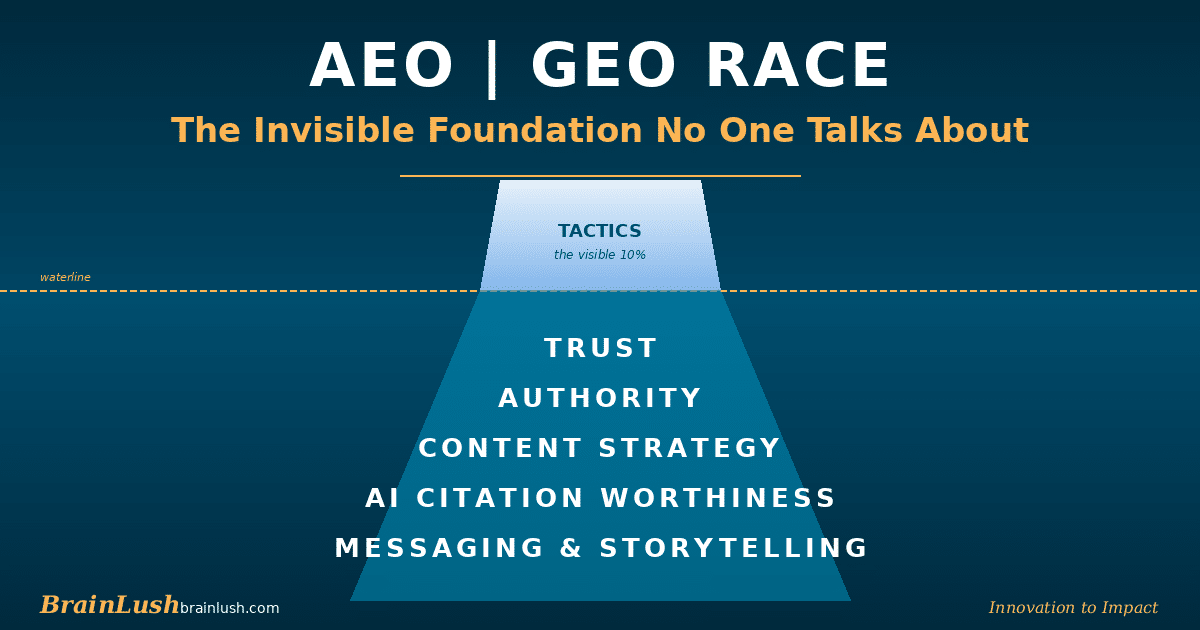
Picture an iceberg.
Above the waterline — what most of the conversation focuses on — sits the visible 10%: keyword tactics, schema hacks, “5 ways to optimize for ChatGPT” listicles. Useful, but cosmetic.
Below the waterline — where 90% of the work actually lives — sits the foundation:
Trust.
Authority.
Content Strategy.
AI Citation Worthiness.
Messaging & Storytelling.
Five layers, working together, deciding whether AI engines treat your brand as a source worth quoting.
This is the foundation worth talking about — because it’s deep work. The strategic work. The work that compounds.
AI citations are won below the surface — in the 90% of foundational layers.
Christy Hui, Founder, Brainlush
AEO vs SEO: What’s Different and Why Does It Matter?
Element
Traditional SEO
Answer Engine Optimization (AEO)
Goal
Rank in blue links
Be cited by AI as the answer
Success metric
Clicks, traffic, rankings
Mentions, citations, share-of-voice
Engines
Google, Bing
ChatGPT, Perplexity, Claude, Gemini, Google AI Overviews
Key signals
Keywords, backlinks, technical SEO
E-E-A-T, structured data, entity graph, Information Gain
Foundation required
Yes
Yes — built ON top of SEO, not instead of it
2026 reality
Mature discipline
Active strategic shift across enterprise
Strong SEO foundations bear AI citation fruit — and life sciences companies have richer soil than most.
Trust: The Uncopiable Asset You’ve Already Built
Trust sits at the deepest part of the iceberg for a reason. It’s the slowest to build, the hardest to fake, and the most heavily weighted by AI engines deciding whether to cite a source.
AI engines evaluate trust by looking for a verified entity — a brand, founder, or company whose identity is consistent across the open web and referenced by multiple authoritative sources that don’t depend on one another. Wikipedia. Industry associations. Peer-reviewed citations. Government databases. Each cross-reference acts like a vote of confidence.
Most B2B companies are still building this. Life sciences companies, on the other hand, mostly already have it — without realizing it. Your peer-reviewed papers, university affiliations, regulatory track records, advisory roles, awards, and patents are exactly the trust signals AI engines actively look for.
The opportunity isn’t earning trust. It’s surfacing what you’ve already earned in a way machines can read.
📊 Healthcare brands receive only 8.7 AI citations per 1,000 queries — 30% fewer than technology brands at 12.3.
Despite handling some of the highest-stakes, most-searched questions on the internet, life sciences brands are under-cited in AI answers — not because the credibility isn’t there, but because the translation layer is the next chapter to build. Gaps are the most valuable real estate in any emerging discipline. This one is wide open.
This is the work that’s been quietly running underneath BrainLush’s positioning. Fifty-eight verified identity URLs. A canonical Person Schema. Cross-platform identity consistency. The kind of slow, deliberate work that doesn’t show up in a campaign dashboard — but shows up the moment ChatGPT decides who to cite.
Trust is the layer that life sciences companies most often already have. Activating it is what unlocks the next layer of visibility.
Authority: Why Your Credentials Are AEO Currency
If trust is who you are, authority is what you’ve earned the right to talk about.
In the SEO era, authority was measured by backlinks and Domain Authority scores. In the AI era, authority is measured differently — and more precisely. AI engines now look at credential-topic alignment. The question isn’t how many sites link to you. Does the author writing about [topic] have the verifiable expertise to be writing about [topic]?
For life sciences companies, this is a structural advantage most haven’t factored in yet.
📊 Adding citations, expert quotations, and statistics — content patterns AI engines recognize as authoritative — boosts visibility in generative engine responses by up to 40%.
Healthcare is the most scrutinized YMYL (Your Money or Your Life) category. The credentials your team has spent careers earning — doctorates, clinical experience, regulatory affairs work, published research — are exactly the kind of authoritative signal AI engines weigh most heavily. The next move: making those credentials show up in the content, structured to be recognizable as expert input.
Audience behavior is shifting in parallel:
📊 22% of U.S. adults now get health information from AI chatbots at least sometimes — and the share is rising fastest among younger demographics.
Health information seeking has moved into AI conversations. The Pew Research data confirms what life sciences leaders are starting to see in their own funnel: investors, clinicians, patients, and partners are increasingly asking AI before they search. Authority isn’t just a nice-to-have — it’s how you get included in those answers.
The companies that win the authority layer are the ones that realize their team’s CVs aren’t just hiring documents anymore. They’re the raw input AI uses to decide whether your brand belongs in the answer.
The work isn’t earning more credentials. It’s making the ones you already have visible — to the right systems, in the right structure, with the right consistency.
Content Strategy: Where SEO and AEO Become One Discipline
Here’s a misconception worth clearing up early: AEO is not a replacement for SEO. It’s the natural extension of it.
Strong AEO is built on strong SEO foundations. Crawlable site architecture. Clean technical health. Topical authority. Internal link structure. Answer-first content. These weren’t optional in the SEO era, and they’re absolutely non-negotiable now — because AI engines pull most of their citations from pages already discoverable in traditional search.
Companies that built deep SEO foundations earn AEO citations faster. The foundation has to be there first — and the good news is that it’s the same work that wins in traditional search, too. Two outcomes, one investment.
There’s also a critical pattern shift worth naming: AI engines reward originality and Information Gain — original perspective and synthesis — over keyword density. Content that rehashes existing top results without adding a new perspective gets demoted. This is a fundamental shift in what “good content” means.
I learned the original lesson up close.
In a previous role leading content marketing for a stealth-mode neuroscience biotech, I deployed a deep content strategy that earned top-3 Google rankings on strategic biomarker keywords — placing our pages alongside the NIH and ahead of major medical institutions.
That work taught me what most marketers haven’t yet grasped: deep SEO content work IS the foundation on which AEO is built. The two disciplines aren’t separate tracks. They’re the same race, with AEO as the new layer on top.
📊 44.2% of all LLM citations come from the first 30% of an article.
AI engines don’t read your content the way humans do. They scan structurally — front-loading attention on the first third, where the answer is expected to live. When your most citable insight lives in the first 30%, AI engines find it instantly. Front-load with intention — and the citations will follow.
What AI Engines Reward in 2026 Content
Signal
Why It Matters
Answer-first structure
44% of LLM citations come from the first 30% of text
Structure beats volume. The brands winning AEO citations aren’t publishing more — they’re publishing with the foundation built first, and the structure designed to be extracted.
AI Citation Worthiness: The Reward of a Strong SEO Foundation
Here’s where the iceberg starts to make sense as one connected thing.
Trust, Authority, and Content Strategy aren’t three separate workstreams. They’re inputs into a single output: how often AI engines cite your brand when someone asks a question in your domain.
We call that output AI Citation Worthiness — and it’s measurable.
AI Citation Worthiness isn’t a vibe. It’s a composite — the natural output of how strong your Trust signals are, how visible your Authority is, how well your Content Strategy is structured for AI extraction, and how consistently those layers reinforce each other across the web. When the foundation is real, the AI citations follow.
This is the part of the framework most strategists glide past because it requires translating foundational work into digital layers that AI machines read and track to earn citations.
📊 62% of AI citations now come from pages ranking BELOW Google’s top 10 — only 38% come from top-10 results, down from 76% in mid-2025.
Domain Authority alone isn’t the gate it used to be. AI Overviews are pulling citations from pages that aren’t even on Google’s first page. Why? Because AI engines reward structure, originality, and verifiable authorship over raw domain strength.
Smaller, well-founded life sciences brands have a real opening here — and the foundation work makes it real.
The seismic shift in how people search is happening now: investors and potential partners aren’t Googling you anymore — half of them are asking ChatGPT, Perplexity, Claude, and Gemini about your company.
The race is no longer ‘do you rank?’ It’s more about ‘does AI cite your brand and science, accurately?’
Christy Hui, Founder, Brainlush
That’s the punchline of the whole iceberg. Visibility used to be a single layer — search rankings. Now there are two: the rankings you earn and the citations you receive. The life sciences brands that win in the AEO era are those whose foundations make them strong in both.
In our AI era, your breakthrough science deserves breakout AI visibility.
Messaging: The Bilingual Advantage Life Sciences Brands Need to Own
The next core layer is content and messaging. For life sciences leadership teams, it might be the most natural to embrace.
Storytelling has always been the translation layer in this industry. Complex science doesn’t move markets on its own. It moves when someone — a CMO, a marketing team, a brand — translates it into something humans can feel. That’s been true since long before AI search existed.
The shift now: there’s a second translation happening simultaneously.
As you navigate AEO and AI search optimization, three translations matter for life sciences leadership teams:
Turning science into story and impact for humans who need to understand it — clinicians, investors, partners, patients.
Together, these three translations form what 2026 marketers call topical authority: comprehensive coverage of a subject through interconnected content. It’s also what AI engines reward most.
This is the bilingual storytelling life sciences brands are uniquely positioned to do well. Your team already knows how to translate science for clinicians, customers, investors, and partners — each in their own language. AEO adds one more audience to that list: the machines synthesizing answers for everyone else.
The work isn’t new — it’s an extension of storytelling and thought leadership that has been going on all along. The same origin story that lands in an investor pitch can be structured to be quotable in AI answers. Same craft. But a new AI dimension of restructuring the data.
This is where brand video and visual storytelling — multi-audience messaging, founder narrative, scientific story brought to life — compound with the foundation layers below. A story without foundation gets seen but not cited. A foundation without stories gets cited but doesn’t move people. Both layers, working together, build the kind of brand AI engines cite and humans remember.
Trust isn’t schema code. Authority isn’t a checkbox. Trust is earned with real work—then translated so AI cites your brand, accurately.
Christy Hui, Founder, Brainlush
That’s the whole iceberg in one line. The foundation is fundamental. The work is deep and meaningful. The race is won by thought leadership that chooses to build it — and translate what they already have into the language AI engines speak. Strategic thinking wins the great AEO race.
Gain AI Visibility: Five Keys to Increase Citations
From innovation to citation. Breakthrough science deserves breakout AI visibility. These five questions reveal your brand’s AI Citation Readiness — and how your core brand content can be encoded to resonate with humans and signal trust to AI — win AI citations.
The Key
Why It Signals Trust to AI
How trustworthy is your content?
Trust is the signal AI weighs most. A verified, credible brand — consistent across the open web — is one AI cites with confidence.
How deep is your content?
Blog posts and press releases speak to humans. AI needs more — depth backed by clinical studies, peer-reviewed research, and measurable impact. That’s the authority AI reads as worth quoting.
How rich is your content?
Rich content — like brand videos that demonstrate how your science works — sends the strongest trust signals AI rewards, far beyond thin, me-too copy.
How consistent is your messaging?
AI cross-references your whole footprint. One unmistakable voice everywhere signals credibility; mixed messages read as noise.
How visible is your content to AI?
AI reads content differently than humans do — through the digital layers beneath the page. If those layers aren’t built for machines to read, AI can’t cite you.
Ready to Get Cited by AI?
Increase AI Visibility with our Brand Voice Fingerprinting™ methodology — encoding your E-E-A-T (Experience, Expertise, Authoritativeness, Trustworthiness) trust signals into your brand voice.
Resonate with people. Signal trust to AI. Win AI citations — accurately and consistently.
Frequently Asked Questions About Answer Engine Optimization
Q: What is answer engine optimization (AEO)?
Answer engine optimization (AEO) is the practice of structuring your brand and content so AI engines — ChatGPT, Perplexity, Claude, Gemini, Google AI Overviews — cite you as a source when delivering direct answers. Whereas SEO optimizes for blue-link rankings, AEO optimizes for inclusion within the AI-generated answer itself.
Q: What’s the difference between AEO and GEO?
AEO (Answer Engine Optimization) and GEO (Generative Engine Optimization) are largely synonymous in 2026, with subtle nuance. AEO emphasizes being cited as a direct answer in featured snippets, AI Overviews, and voice search. GEO emphasizes being cited inside generative AI responses from ChatGPT, Perplexity, and Claude. Most strategic frameworks treat them as a single discipline.
Q: How is AEO different from SEO?
SEO drives traffic by ranking pages in search results. AEO drives visibility by getting cited inside AI answers. They’re complementary — strong AEO is built on strong SEO foundations. SEO measures clicks and rankings; AEO measures mentions, citations, and share of voice across AI platforms. Both matter in 2026.
Q: Why does AEO matter for life sciences companies?
48.75% of all healthcare and life sciences queries trigger AI Overviews — the highest rate among all verticals. AEO is the new visibility layer where investors, partners, clinicians, and customers form first impressions.
Q: How do I get my company cited by AI?
Getting cited by AI engines comes down to five foundational layers: Trust (verified entity, schema), Authority (credentialed expertise made machine-readable), Content Strategy (answer-first, Information Gain, structured data), AI Citation Worthiness (the composite output), and Messaging & Storytelling. When the foundation is built, citations follow.
Q: What is E-E-A-T, and how does it affect AI citations?
E-E-A-T stands for Experience, Expertise, Authoritativeness, and Trustworthiness — Google’s quality framework, now adopted by AI engines for source selection. Authoritative content patterns — citations, expert quotations, and statistics — boost visibility in generative engine responses by up to 40%. For life sciences brands, where YMYL stakes are highest, E-E-A-T is foundational.
Q: Why are healthcare brands under-cited in AI search?
Healthcare brands receive only 8.7 AI citations per 1,000 queries — 30% fewer than technology brands at 12.3 — despite handling some of the highest-volume, highest-stakes queries online. The under-citation gap reflects an opportunity: most life sciences brands are ready to translate existing credibility into machine-readable signals. The opening is wide. Life sciences companies that move now will have first-mover advantages.
Q: What kind of content gets cited by AI engines most often?
AI engines preferentially cite content that’s answer-first, originally insightful (high Information Gain), structurally clean (clear headings, comparison tables, schema), credentialed (verified author byline), and recent. Well-structured articles — with clear headers, scannable sections, front-loaded answers, and verified authorship — consistently earn AI citations.
Q: Do I need schema markup to be cited by AI?
Schema isn’t strictly required, but it materially increases your odds. Properly structured Article, FAQPage, Person, and Organization schema make your content machine-readable in ways unstructured prose can’t match. Pages with full schema deployment show higher selection rates in AI Overviews.
Q: Should life sciences leadership teams be paying attention to AEO right now?
Yes — strategically. 70% of organizations believe AEO will significantly reshape their digital strategy within 1-3 years, but only 20% have begun implementing it. That gap is a first-mover window for leadership teams who start building the foundation now, before the category gets crowded.
Q: How long does AEO take to show results?
Foundation-dependent. Brands with established SEO infrastructure can see initial AEO citations within weeks. Brands starting from scratch typically see meaningful gains within 60-120 days, with compounding visibility thereafter. The foundation determines the timeline.
Q: Can I do AEO myself, or do I need an agency?
Both paths work — the question is bandwidth. DIY requires strategic marketing leadership, deep expertise in SEO and schema, and dedicated execution time. Most life sciences leadership teams are better served by a strategic partner who can compress 12 months of foundation work into a focused engagement. In contrast, internal teams stay focused on science and their audiences.
Q: What’s the ROI of answer engine optimization (AEO)?
AI-driven visitors convert at 4.4x the rate of standard organic traffic and spend 68% more time on site. AI referral traffic also converts at roughly 2x the rate of traditional organic search. The compounding effect shows up across investor conversations, partnership discussions, and audience research — not just web traffic. That’s the actual return. Wondering where you stand today? A Custom AI Visibility Report shows what AI engines already say about your brand.
Here is the beautiful thing about AEO work: AI-driven visitors are your potential customers, and when you are cited, you meet them right where they are. AI citation is the new rocket in modern marketing. The conversion data proves it.
📊 AI-driven visitors convert at 4.4x the rate of standard organic visitors and spend 68% more time on site.
References
Conductor. 2026 AEO/GEO Benchmarks Report — Health Care Industry.
Ahrefs (Louise Linehan). Update: 38% of AI Overview Citations Pull From The Top 10.
Aggarwal, P., Murahari, V., Rajpurohit, T., Kalyan, A., Narasimhan, K., & Deshpande, A. GEO: Generative Engine Optimization.
Semrush (Rachel Handley). We Studied the Impact of AI Search on SEO Traffic.
Pew Research Center. Health Information from Social Media and AI Rated More Convenient than Accurate.
Acquia & Researchscape International / GlobeNewswire. Survey: 70% Say AEO Will Reshape Digital Strategy.
Indig, Kevin. The Science of How AI Pays Attention. Growth Memo, February 2026.
Meet the Author
Christy Hui
Christy Hui is the founder of BrainLush — an AEO Strategist & Activator and Fractional CMO for biotech and life sciences brands. An award-winning brand storyteller with 25+ years driving growth from startups to Fortune 500 and IPO. She transforms innovations into impactful narratives that resonate with people and signal trust to AI, increasing brand visibility. Through her Brand Voice Fingerprinting™ methodology, Christy encodes your unique brand voice as trust signals so ChatGPT, Perplexity, Claude, and Gemini cite your brand accurately and consistently. Her media and brand video production work has earned numerous industry awards. MBA. Fluent in English and Chinese.
AI Citation Readiness
Is AI Citing Your Brand—Accurately?
ChatGPT, Claude, Perplexity, and Gemini are answering questions about your science right now. Find out what they say—and what they get wrong—before your buyers do.