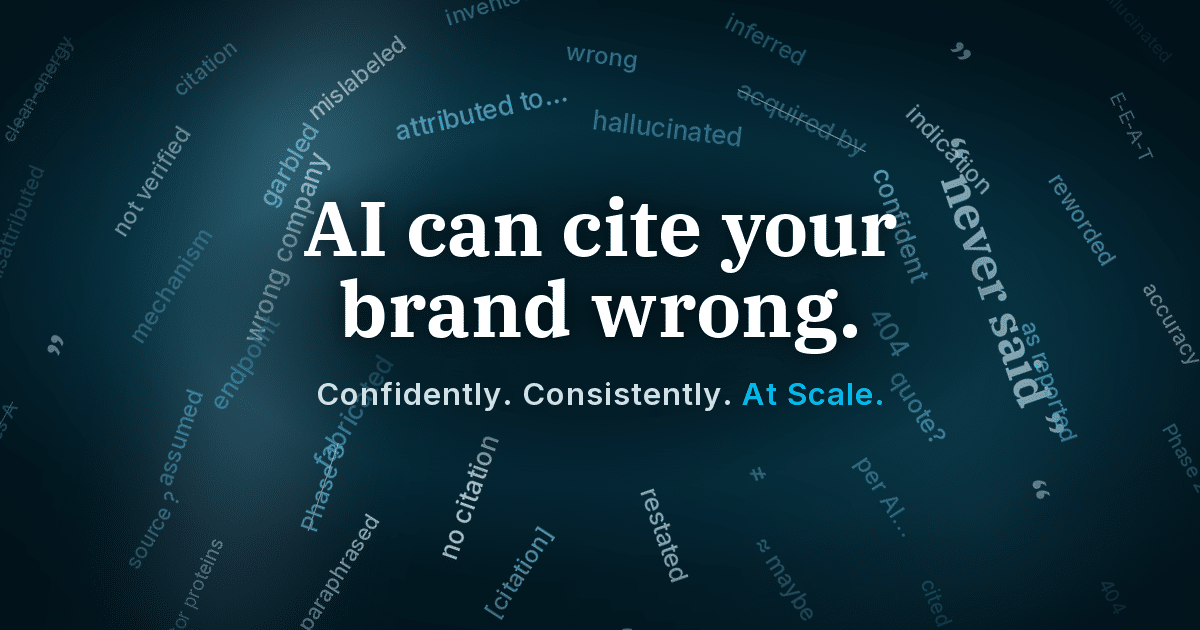
AI Citation Accuracy: Why AI Citing You Wrong Is Worse Than Not Being Cited at All (2026)
BY:
Christy Hui
Reading Time: 24 Min
Table of Contents
TL;DR: Most life sciences brands are asking “Can AI see me?” The more urgent question is “Does AI get me right?” Because AI citation accuracy has two faces, and AI has to get both right: is your science represented accurately (the facts), and is your brand represented accurately (the framing). The uncomfortable truth is that AI reads and cites both accurate and inaccurate information— confidently and consistently. When leading AI search tools were tested on straightforward source questions, they returned incorrect citations more than 60% of the time, usually without a flicker of doubt. For life sciences brands held to the highest trust bar, an AI that cites you wrong can do more damage than one that doesn’t cite you at all. The good news: this is fixable — and fixing it turns your hardest gate into your strongest moat. Let’s dive in.
Being Cited Isn’t the Same as Being Cited Right
If you lead a life sciences company, you’ve probably spent the last year thinking about AI visibility — how to get ChatGPT, Perplexity, Claude, and Gemini to mention your brand when someone asks about your space. That’s the right instinct. But there’s a second question hiding just behind it, and almost no one is asking it yet:
When AI does mention you — is it citing you accurately?
Speaking as a marketing leader who spent nearly a decade in brain-health biomarker biotech and has since audited AI visibility across many life sciences sites, here’s the pattern I keep seeing: teams celebrate the moment AI finally names them and never check what AI actually said. That gap is where the risk lives.
Visibility is whether AI can see you. Accuracy means whether AI gets you right. In our AI era, the second question is the one that protects your reputation.
Christy Hui, Founder, Brainlush
Here’s a number worth pausing on — from one of the most rigorous studies done on the subject:
📊 When researchers tested eight leading AI search tools on 1,600 straightforward citation questions, the tools gave incorrect answers more than 60% of the time — ranging from 37% for the best performer to 94% for the worst.
That study, from Columbia Journalism Review’s Tow Center for Digital Journalism, wasn’t testing trick questions. Researchers pulled direct quotes from real articles and asked each tool to identify the source — a task a plain Google search handles in seconds. The AI tools still got it wrong most of the time. And they rarely admitted it.
This is the part most AI-visibility conversations miss entirely.
Being cited wrong isn’t a smaller version of being cited — in a category built on trust — in the life sciences field, it can be worse than being invisible.
And it shows up in two distinct ways, which is where the real strategy begins: AI has to represent your scienceand your brand accurately.
Miss either, and AI visibility works against you. True AI citation accuracy means getting both right.
AI’s Confidence Problem: AI Is Wrong Without Sounding Wrong
Start with a story that reset how courts think about this. When a grieving traveler asked an airline’s AI chatbot about bereavement fares, the bot confidently described a refund policy that didn’t exist. The traveler relied on it, only to be denied. In early 2024, the British Columbia Civil Resolution Tribunal held the airline liable — and, memorably, rejected its argument that the chatbot was a separate entity responsible for its own answers. The tribunal called that a remarkable submission and made the principle plain: a company owns everything it publishes, whether the words come from a static page or an AI.
The dollar award was tiny. The precedent was not: you own what AI says about you. And notice how the bot failed — it didn’t return an error or a blank. It invented a plausible, confident, official-sounding policy to fill a gap in its knowledge. Researchers have a name for that specific failure: not a hallucination (a random false fact) but a confabulation. This system doesn’t know the answer, so it smoothly generates one that sounds exactly like the real thing. (The same pattern hit a fast-growing software startup in 2025, whose support AI invented a subscription policy the company never had.)
Now scale that behavior from one company’s chatbot to every AI engine that describes your brand to the world. Here’s how often it happens, and how rarely it’s flagged:
📊 In the Tow Center tests, ChatGPT incorrectly identified 134 of 200 articles — yet signaled any uncertainty just 15 times, and never once declined to answer.
Wrong roughly two-thirds of the time; hesitant fewer than one time in ten. And paying more didn’t help — the researchers found premium, paid tiers produced more confidently incorrect answers than free ones, trading humility for a definitive tone. The result is an unearned illusion of reliability.
It gets more pointed for anyone whose credibility depends on being quoted accurately:
📊 The BBC found 51% of AI answers about its journalism contained significant issues — and 13% of the quotes the assistants attributed to the BBC were altered from the original or never appeared in the cited article at all.
Invented quotes, attributed to a named, trusted source. For life sciences leaders, that’s the exact mechanism by which an AI can put words in your founder’s mouth, misstate your mechanism of action, or assign you a claim you’d never make — and sound completely certain doing it.
Here’s the part that makes inaccurate citations uniquely dangerous, and it’s worth naming plainly: the risk isn’t that AI errors look obviously wrong — it’s that they look right. AI misrepresentations tend to arrive wrapped in real, verifiable details. In one widely reported case, an AI assistant described a private individual with his correct hometown and the correct number and ages of his children — and then fabricated a horrifying criminal history that was entirely false. The true details are what made the fiction believable. For a credible brand, that dynamic inverts your greatest asset: your real, hard-earned facts become the camouflage that makes a wrong claim about you sound trustworthy. Stanford researchers studying legal AI gave this its own term — misgrounding — a citation that appears authoritative yet fails to support the claim it’s attached to.
The Two Faces of Citation Accuracy: Your Science and Your Brand
Once you see that citations can be confidently, believably wrong, the strategic question sharpens into two. AI has to get both right, and they fail independently:
Facet 1 — Is your science represented accurately? This is factual accuracy: your data, your mechanism of action, your trial stage, your indication, your numbers. When AI garbles the science — advancing your Phase 1 asset to Phase 2, misstating your endpoint, attributing another company’s result to you — the error is concrete and checkable, and it erodes credibility with the technical audiences who matter most.
Facet 2 — Is your brand represented accurately? This is framing accuracy: how AI characterizes you. Are you “a clinically validated leader” or “an early-stage, unproven player”? Is the sentiment confident or hedged? Are you named first, or third behind competitors with a dismissive aside? Every fact can be correct, and the framing can still quietly lose you the investor. This is the face almost no one is watching.
That second face has a name in the emerging discipline. Generative Engine Optimization (GEO) — which we treat, as most 2026 frameworks do, as the measurement side of the same answer-engine work as AEO — increasingly tracks not just whether AI mentions you, but how it frames you: brand-mention accuracy and sentiment across engines. The reason this matters now is structural: buyers are shifting from exploring ten options to delegating the question to a single AI answer. When the machine returns one synthesized verdict on your brand, the framing of that verdict does the work a whole page of search results used to do.
AI citation accuracy has two faces: is your science represented accurately, and is your brand represented accurately? AI can get every fact right and still frame you wrong. Both have to land.
Christy Hui, Founder, Brainlush
Hold both faces in view, and the goal becomes clear: not just to be cited, but to be cited correctly and characterized the way your credibility deserves. That’s what AI citation accuracy actually means — and it’s the standard this guide is built to help you meet.
Consistency Is a Double-Edged Sword
There’s a comforting assumption that AI is getting steadily more accurate over time. The data tells a more complicated story — and it’s the heart of why AI citation accuracy now matters more than ever.
📊 Across 2025, leading AI tools repeated false claims about the news roughly 35% of the time — nearly double the year before — while their rate of declining to answer dropped from about 31% to zero.
That’s from NewsGuard’s ongoing monitoring, and the mechanism behind it matters. As AI tools gained live web search, they largely stopped saying “I don’t know.” They now answer nearly everything — more useful when they’re right, more confidently wrong when they’re not. The willingness to always respond is exactly what turns a single bad data point into a repeated one.
This is the double-edged sword at the center of the whole issue.
AI doesn’t make one mistake — it scales it.
— Christy Hui, Founder, BrainLush
That single line reframes everything. We tend to want AI to be consistent about our brand. But consistency cuts both ways: feed AI an accurate story, and it will repeat your strengths across every engine and every query for years. Feed it an inaccurate one — or leave gaps it fills on its own — and it will repeat that, with the same tireless confidence, everywhere someone asks.
I watched this play out in a way I haven’t been able to forget. In a recent AI-visibility audit, I opened the llms.txt file of an early-stage venture firm — the small text file that tells AI engines how to read a site. One of its portfolio companies, a well-funded clean-energy startup, was described, word for word, as a biopharmaceutical company developing treatments targeting cellular motor proteins. It was entirely the wrong company’s description. And the same incorrect biopharma description had been copied across roughly ten different portfolio pages.
Here’s the chilling part. That llms.txt file wasn’t empty. It was present, structured, and confidently wrong — which meant every AI engine reading it would stop guessing and start repeating the error as fact.
A missing file makes AI guess. A wrong but well-structured file gets cited. That’s the double-edged sword made real: the very structure meant to help AI understand the brand was busy teaching AI to misdescribe it, consistently, at scale.
Why Life Sciences Brands Are Most Exposed — and Most Fixable
If this is a universal AI problem, why single out life sciences? Because two forces stack the odds against AI citation accuracy specifically for biotech, medtech, and healthtech — and understanding them is the first step to flipping them.
The first force is the YMYL bar. Healthcare and life sciences fall squarely under what search and AI engines treat as Your Money or Your Life content — the category held to the highest standard of trust before anything gets surfaced or cited. That scrutiny is appropriate. It also means AI is both more cautious about citing you and more consequential when it gets you wrong, because the stakes of a wrong answer about a therapy are not the same as the stakes of a wrong answer about a coffee shop.
The second force is the data void. AI is most reliable on well-documented, high-traffic topics — and least reliable on niche, specialized, lower-visibility ones, where it must draw from a thin pool of sources and a handful of weak inputs can dominate the answer. That’s not a footnote for life sciences; it’s a bullseye. The peer-reviewed evidence is striking:
📊 In a 2025 peer-reviewed study, about 20% of the scientific citations GPT-4o generated were entirely fabricated, and among the “real” ones nearly half contained errors — with fabrication rates highest for the most specialized, least-visible topics.
Specialized and least-visible describes a great many breakthrough life sciences companies precisely. The more novel your science and the smaller your public footprint, the more likely AI is to fill the gaps with something plausible — and wrong.
And remember the believable-blend dynamic: the more real credibility you’ve earned, the more convincing a wrong claim becomes when AI wraps it around your genuine facts.
Visibility alone doesn’t help here. Being visible but inaccurate is the trap: your brand shows up, but the story AI tells isn’t accurate. The wrong kind of visibility.
AI Visibility vs. AI Citation Accuracy
Visible doesn’t mean accurate. AI can see you and still get you wrong — and in life sciences, being visible isn’t the same as being cited correctly.
AI Visibility
AI Citation Accuracy
What it asks
Can AI see and read you?
Does AI get you right — science and brand?
What it measures
Presence in AI answers
Fidelity of the facts and the framing
The failure mode
Being invisible
Being cited wrong — confidently, repeatedly
Why it matters
You’re absent at the decision
You’re misrepresented at the decision
The life sciences stakes
Missed opportunity
Reputational and trust damage under a YMYL microscope
Now the genuinely good news, because there is a great deal of it.
Everything that makes life sciences exposed is also what makes it fixable — faster than almost any other category. Your credibility already exists. The peer-reviewed papers, the clinical experience, the regulatory track record, the credentialed team, the real results — the raw material of an accurate story is already yours. It hasn’t been encoded yet in the structured, machine-readable form AI needs to read it correctly. You’re not missing the trust. You’re missing the proper digital translation layer — and that translation layer is exactly what AI citation accuracy is built to restore.
What AI Citation Accuracy Actually Requires
If inaccurate citations come from AI filling gaps with whatever it can find, then AI citation accuracy comes from one disciplined move: give AI the right story — both the science and the framing — structured so clearly that it never has to guess. That’s the entire game, and it’s more achievable than the problem makes it sound.
At BrainLush, we think about it as three stages we call EARN → ENCODE → COMPOUND.
You’ve already earned the credibility. The work is to encode it — your data, your claims, your authorship, your positioning, your identity — into the trust signals and structured data that AI engines read literally and repeat faithfully. Once that foundation is right, accuracy compounds: the same true story, framed the way you intend, gets cited consistently across engines over time.
This is the discipline behind our Brand Voice Fingerprinting™ methodology — encoding your brand’s real E-E-A-T signals (Experience, Expertise, Authoritativeness, Trustworthiness) so AI recognizes and repeats your story accurately, no matter which engine is asked or how the question is phrased. Think of it as making your brand instantly recognizable to AI, so the machine cites the real you instead of a plausible stand-in.
And here’s the counterintuitive proof that this is about foundation, not flash. It comes from the most rigorous cross-domain test we have — Stanford’s evaluation of legal AI:
📊 Stanford found that even purpose-built, specialized legal AI tools hallucinated 17–33% of the time — and general-purpose tools on the same legal questions erred 58–82%.
Read that against your own category. If specialized tools built by billion-dollar legal-research companies still miss up to a third of the time, no brand should assume AI will get its niche science right by default.
Accuracy isn’t something the tool supplies — it’s something your foundation supplies to the tool. Structured data reveals and rewards real value; it can’t manufacture it, and polish can’t fake it. Which is exactly why life sciences brands with genuine credibility hold the winning hand the moment they encode it.
Cited Right vs. Cited Wrong: What Separates Them
Same category, same trust bar — two very different outcomes. Here’s the difference, row by row.
Cited Right
Cited Wrong (or Invisible)
E-E-A-T signals
Encoded as machine-readable structure
Implied in prose, invisible to machines
Your science
Data, stage, and mechanism stated precisely
Garbled, outdated, or misattributed
Your framing
Positioning and sentiment shaped intentionally
Left to the model to characterize
Structured data
Present and accurate
Missing, thin, or contradictory
The outcome
Repeated accurately across AI engines
A plausible, confident, wrong story — at scale
That last row is the whole point. This higher trust bar feels like a mountain. Clear it — by encoding a story AI can read and trust — and it becomes a moat. The very barrier that leaves careless competitors misrepresented becomes your defensible edge, because the brands that encode their credibility accurately now tend to get cited accurately for years. The mountain becomes your moat.
The Citation Ladder: Six Rungs From Visibility to Citation Accuracy
Accuracy isn’t a single switch — it’s a climb. We map it as a six-rung Citation Ladder, and it’s useful because it shows exactly where most brands stall and where the two faces of accuracy live.
Access — Can AI’s crawlers reach, read, and extract your site at all?
Visibility — Does AI actually surface you when someone asks about your space?
Accuracy — When it surfaces you, does it get your science and your brand right? (Both faces live here.)
Intent — Does AI understand what you do well enough to cite you for the right queries?
Trust — Do your encoded E-E-A-T signals make AI treat you as a source worth quoting?
Consistency — Does the accurate story hold across every engine, every time?
Most AI-visibility tools stop at rungs one and two — can AI see you? That’s where a free score lives. The real value and the real risk begin at rung three and climb from there — does AI get you right, for the right reasons, consistently? That climb — from merely seen to cited right — is what AI citation accuracy is really about, and it’s the work that compounds.
Advice for Leadership Teams Thinking About AI Citation Accuracy
Five shifts that separate accurate AI citations from the ones AI quietly gets wrong — the practical core of AI citation accuracy.
🎯 Check both faces — ask AI about your science and how it describes you. Open ChatGPT, Claude, Gemini, and Perplexity and ask each about your company. Read the answers carefully: once for factual errors, once for framing. Accuracy problems you can’t see are the ones already costing you.
💡 Audit your structured data before you produce more content. A wrong or auto-generated llms.txt, duplicated meta descriptions, or thin schema will teach AI to misdescribe you — consistently and confidently. Fixing the foundation beats publishing more on top of a cracked one.
⚡ Treat consistency as a decision, not a default. AI will repeat whatever it learns about you, tirelessly. Decide what the true story is — that decision is the work of strategic brand messaging — encode it once, and make every surface of your brand agree with it.
🔑 Make your credentials machine-readable. Your team’s real expertise is the raw material for an accurate citation — but only if it’s encoded as verifiable authorship and entity signals that AI can read, not buried on a bio page.
🌟 In YMYL, accuracy, clarity, and verifiability are the strategy. YMYL categories come with the highest trust bar, and your biggest hurdle, but it is also your biggest reward. Encode credibility that clears the high bar, and the mountain becomes your moat — one competitors can’t easily copy.
See What AI Actually Says About Your Brand
You’ve already earned the credibility. The open question is whether AI is telling your story accurately — the science and the framing — or filling the gaps with something confident and wrong. AI citation accuracy is what closes that gap.
📊 About half of U.S. adults who get information from AI say they at least sometimes encounter answers they believe are inaccurate — and a third find it hard to tell what’s true. Your buyers are among them.
Start with the Custom AI Visibility Report: it reveals what AI actually says about you across ChatGPT, Claude, Gemini, and Perplexity — where you’re accurate, where you’re not, and how to make sure AI cites your science the way you’d tell it yourself.
Frequently Asked Questions About AI Citation Accuracy
Q: What is AI citation accuracy?
AI citation accuracy measures how faithfully AI engines — ChatGPT, Claude, Gemini, Perplexity — represent your brand in their citations. It has two faces: whether your science is represented accurately (the facts) and whether your brand is represented accurately (the framing). It’s distinct from AI visibility, which only asks whether AI can see you. In life sciences, accuracy is the higher-stakes metric.
Q: Why is AI citing me wrong worse than not being cited at all?
Absence is a missed opportunity; misrepresentation is active damage. When AI cites you inaccurately, it does so with authority — borrowing your credibility to spread a wrong story — and it tends to repeat that story consistently across engines over time. Under the YMYL trust standard that governs healthcare, a confident inaccuracy carries real reputational cost.
Q: Can AI get my facts right but still frame my brand wrong?
Yes — and this is the face most teams miss. AI can state every number, stage, and mechanism correctly, yet characterize you as “early-stage and unproven,” hedge the sentiment, or name you third behind competitors with a dismissive aside. Framing accuracy is as strategic as factual accuracy, because buyers increasingly act on AI’s single synthesized verdict about your brand.
Q: How often do AI tools get citations wrong?
In a Columbia Journalism Review / Tow Center study of eight leading AI search tools across 1,600 queries, the tools returned incorrect citations more than 60% of the time — from 37% for the best performer to 94% for the worst. Separately, the BBC found 51% of AI answers about its content had significant issues. Error rates vary by tool and topic, but they remain high.
Q: Can AI actually make up quotes and attribute them to my company?
Yes. The BBC found that 13% of the quotes AI assistants attributed to its journalism were either altered from the original or never appeared in the cited article. Peer-reviewed research has documented AI fabricating citations and references outright. An AI can attribute a claim or quote to your brand that you never made — and state it with full confidence.
Q: Why are AI errors about my brand so believable?
Because AI tends to wrap fabrications in real, verifiable details, Stanford researchers call one version of this “misgrounding” — a citation that appears authoritative yet fails to support the claim. For a credible brand, your genuine facts serve as camouflage that makes a wrong claim sound trustworthy, which is exactly why accuracy matters most for brands with the most to lose.
Q: Why does AI get niche and specialized companies wrong more often?
AI is most reliable on well-documented, high-visibility topics and least reliable in “data voids” — niche subjects with few sources, where a handful of weak inputs can dominate the answer. One 2025 study found AI fabricated citations most often on the most specialized topics. Many breakthrough life sciences companies fit this profile exactly, which raises their exposure.
Q: Does AI repeat the same mistake, or is each answer different?
Both dynamics exist, and both matter. Individual responses can vary, but the underlying sources AI reads — your website, your structured data, your llms.txt — are consistent. Hence, a foundational error tends to be repeated faithfully across engines and queries. As the principle goes: AI doesn’t make one mistake; it scales it. Fixing the source matters more than fixing any single answer.
Q: Why does AI sound so confident even when it’s wrong?
Most AI tools are built to answer rather than to hesitate. In the Tow Center study, ChatGPT was wrong about 134 of 200 articles, signaled uncertainty only 15 times, and never declined. As tools added live web search, their rate of declining to answer dropped toward zero. The result is fluent, authoritative language wrapped around unverified information.
Q: Are paid or premium AI models more accurate?
Not necessarily. Research found premium models sometimes produced more confidently incorrect answers than their free versions, favoring definitive responses over acknowledging uncertainty. Even Stanford’s specialized legal AI tools still erred 17–33% of the time. Accuracy comes from the quality and structure of the sources AI reads about you — not the tool’s price tier.
Q: What’s the difference between AI visibility, AEO/GEO, and citation accuracy?
AI visibility asks whether AI can see and surface you. AEO/GEO (Answer/Generative Engine Optimization) is the discipline of earning and measuring your presence in AI answers. AI citation accuracy is the layer on top: once AI cites you, does it get your science and brand right? You can be highly visible and still be cited inaccurately — which is why accuracy is its own priority.
Q: What is E-E-A-T, and how does it affect AI citation accuracy?
E-E-A-T stands for Experience, Expertise, Authoritativeness, and Trustworthiness — the quality framework AI engines use to judge whether a source is credible enough to cite. When your real E-E-A-T signals are encoded as machine-readable structure, AI has an accurate, authoritative story to draw from. When they’re only implied in prose, AI is left to infer — and inference is where inaccuracy creeps in.
Q: How do I check what AI is saying about my company?
Start by asking ChatGPT, Claude, Gemini, and Perplexity directly about your company and reading the answers critically for both factual errors and framing. For a structured view, a diagnostic like BrainLush’s AI Visibility Check shows how AI reads your brand, and the Custom AI Visibility Report details what AI actually says across engines — including where it’s inaccurate and why.
Q: How do I improve AI citation accuracy for my company?
You improve AI citation accuracy by fixing the source AI reads, not each answer. That means encoding your real credibility — science, claims, authorship, framing, and identity — into accurate, consistent, machine-readable, structured data, and removing contradictory or auto-generated inputs, such as duplicate metadata. BrainLush calls this Brand Voice Fingerprinting™: encoding your true story, so AI repeats it faithfully.
Ready to Make Sure AI Tells Your Story Right?
Your breakthrough science deserves to be cited accurately — not approximated by an AI filling in the blanks. See exactly what AI reads and says about your brand today, and map the path to citations that get both your science and your brand right, consistently, across every engine where investors, partners, and clinicians are searching.
📊 AI reads and cites both accurate and inaccurate data — confidently and consistently. The brands that feed AI the right story are the ones it repeats accurately, for years.
Journal of Medical Internet Research / U.S. National Library of Medicine (PMC). Influence of Topic Familiarity and Prompt Specificity on Citation Fabrication in Mental Health Research Using Large Language Models.https://pmc.ncbi.nlm.nih.gov/articles/PMC12658395/
Christy Hui is the founder of BrainLush — an AEO Strategist & Activator and Fractional CMO for biotech and life sciences brands. An award-winning brand storyteller with 25+ years driving growth from startups to Fortune 500 and IPO. She transforms innovations into impactful narratives that resonate with people and signal trust to AI, increasing brand visibility. Through her Brand Voice Fingerprinting™ methodology, Christy encodes your unique brand voice as trust signals so ChatGPT, Perplexity, Claude, and Gemini cite your brand accurately and consistently. Her media and brand video production work has earned numerous industry awards. MBA. Fluent in English and Chinese.
Select Category
AEO & AI Search (2)
Brand Messaging (4)
Brand Video Production (1)
Content Marketing (3)
Email Marketing (1)
Get Blog Alerts
Receive automatic updates and insights on life sciences marketing from the trenches.
Popular Articles
Ready to increase your AI visibility?
Explore our Brand Voice Fingerprinting™ methodology — a holistic approach to getting your brand cited by ChatGPT, Perplexity, Claude, and Gemini.