🎯 Win AI Citations
AI Visibility · Answer Engine Optimization
This AEO FAQ for life sciences answers the questions biotech, medtech, and healthtech leaders ask us most — what answer engine optimization is, how AI citations work, why accuracy matters more than visibility, and what it takes to win citations in a YMYL category.
TL;DR
In our AI era, answer engine optimization (AEO) is how your brand gets discovered—through citations—when people search on ChatGPT, Perplexity, Claude, Gemini, and Google’s AI Overviews. In life sciences—biotech, medtech, healthtech—the trust bar is highest and the reward is biggest. At BrainLush, we build the digital layers that encode your E-E-A-T credibility signals—Experience, Expertise, Authoritativeness, Trustworthiness—into your website, so AI reads, extracts, and cites your brand accurately and consistently. Citations compound: organic, evergreen, earned.
Our mission: help breakthrough innovations earn breakthrough visibility.
Resonate with people. Signal trust to AI. Win AI citations—accurately and consistently.
Bookmark this AEO FAQ for life sciences. AI is ever-evolving, and we update these answers as AEO, GEO, and SEO reshape marketing and corporate communications.
I get this question in nearly every conversation with business leaders. AI changes both marketing and communications at once. How? Your next investor, partner, or clinician now meets your company through AI—often before they land on your website. 48.75% of healthcare-related queries now trigger an AI Overview. Marketing no longer competes for the click; it competes to be cited by AI as the source. Communications no longer carries your brand narrative alone—generative AI engines interpret it and tell it their way. Shaping how they tell it is the work of generative engine optimization (GEO).
And AI cites whatever it reads about you, faithfully, whether or not it’s right. When AI doesn’t know? It makes it up, filling in the blanks for you.
“AI doesn’t make one mistake. It scales it.”
Christy Hui, Founder & CEO, BrainLush
An accurate AI citation compounds—organic, evergreen, earned. A wrong one repeats everywhere, with confidence. So our work asks two questions: can AI see you—and does AI cite you right?
Answer engine optimization (AEO) is how you take control: encoding your narrative, your messaging, and your entity trust signals so every AI model carries the official version. If you lead a life sciences company, treat this AEO FAQ for life sciences as your knowledge bank: the basics of SEO, GEO, and AEO; how AI is changing marketing and corporate communications; what AEO work costs; and what it takes to earn accurate AI citations.
Ask the engines. Open ChatGPT, Claude, Gemini, and Perplexity and ask what they know about your company, your category, and who they’d recommend in your space. If you’re absent—or described wrong—AI is deciding without you. For the structured version, our AI visibility practice starts every engagement by measuring exactly this.
An AI citation is when an AI engine names or links your brand as a source inside its answer—“according to BrainLush…” or a source panel listing your page. It’s the AI-era equivalent of ranking #1, except stronger: the engine isn’t listing you among ten options; it’s vouching for you inside the one answer people read.
Your AI citation rate is how often AI engines include your brand when answering relevant questions in your category. Ask the same set of buyer questions across engines: the percentage of answers citing you is your rate. About 90% of brands sit at or near zero—which means the field is still wide open.
Usually structure, not quality. The common causes: trust signals implied in prose instead of encoded as machine-readable data, thin or missing schema, no llms.txt, and content written only for human readers. AI can’t cite what it can’t confidently read—and most life sciences sites haven’t been translated for machines yet.
Query each engine directly and read critically—once for facts, once for framing. Then get the structured view: the Custom AI Visibility Report maps your citation rate, accuracy, and gaps across ChatGPT, Claude, Gemini, and Perplexity, so you know precisely where you stand before spending on fixes.
Answer engine optimization is the discipline of earning your brand a place inside AI-generated answers—not just search results. Where SEO optimizes for a page of blue links, AEO optimizes for the single synthesized answer an AI engine gives. The work: publishing content and structured trust signals so clear and credible that the answer includes you, accurately.
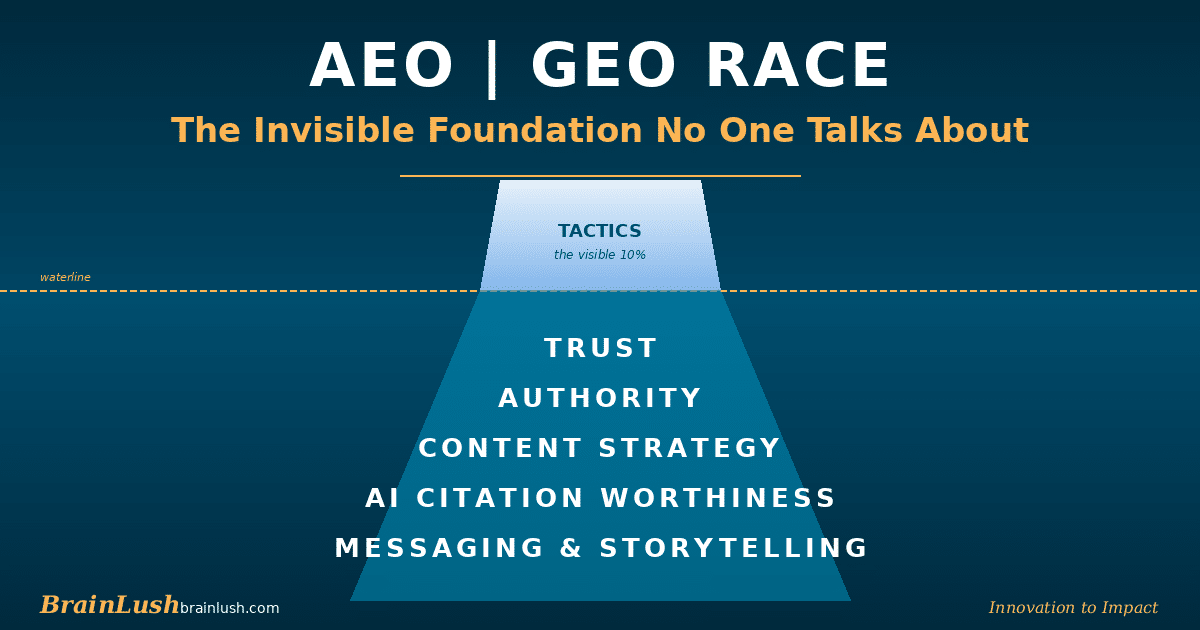
AEO stands for Answer Engine Optimization. The “answer engines” are ChatGPT, Perplexity, Claude, Gemini, and Google’s AI Overviews—systems that answer questions directly rather than listing links. For the complete framework, see our deep dive: The AEO Iceberg: Answer Engine Optimization for Life Sciences.
Essentially, yes. GEO (Generative Engine Optimization) and AEO describe the same work from two angles: AEO frames it around answer engines; GEO leans measurement—tracking mentions, sentiment, and accuracy across engines. Most 2026 frameworks treat them as one discipline. What matters isn’t the acronym—it’s whether AI cites you, and cites you right.
Because buying behavior moved. 48.75% of healthcare-related queries now trigger AI Overviews, and AI-referred visitors convert at 4.4x the rate of traditional organic traffic. When one synthesized answer replaces ten blue links, being in the answer is the new page one—and budgets across biotech, medtech, and healthtech are recalibrating to match.
“AI doesn’t browse. It extracts, answers, and fills the blanks. Your brand either lives in that answer—or AI writes it for you.”
CHRISTY HUI · Founder & CEO, BrainLush
Rich, structured, verifiable content. AI engines reward original depth—brand video, founder-led storytelling, data-backed thought leadership, case studies—wrapped in machine-readable structure: schema, entity signals, clear authorship. Thin, generic pages get skimmed; rich content with encoded credibility gets cited. Depth wins twice: it resonates with people and signals trust to AI.
Enormously—with one catch. AI can’t watch your video, but it reads everything around it: VideoObject schema, transcripts, captions, chapters, and the page it lives on. A brand video encoded this way becomes one of the richest trust signals you can publish; unencoded, it’s invisible. That encoding is core to our brand video production work.
Not by itself. Volume without depth reads as noise; AI cites the clearest credible source, not the most prolific one. Rich content wins: original research, case studies, thought leadership, and brand video—the most evergreen brand asset a company can invest in—each encoded with schema so AI reads the credibility behind it. Evergreen content earns evergreen visibility.
llms.txt is a plain-text file at your domain root that tells AI engines, in their native reading format, what your company is, does, and stands for. Think of it as your brand’s official statement to AI. Present and accurate, it anchors every AI answer about you; missing or wrong, it leaves engines guessing—or worse, repeating someone else’s version.
An entity knowledge graph is your company’s verified record in machine-readable form: publications, patents, leadership credentials, and the relationships between them—each confirmed against a primary source, encoded as structured data, and published at your domain. It gives AI one traceable version of your company instead of guesswork.
Because it removes AI’s need to guess. With a verified, structured record at your domain, engines trace every claim to a primary source and cite you with confidence. BrainLush builds that registry—compilation, verification, encoding, publication, validation—so your credentials become citable evidence.
SEO earns rankings on a page of links. AEO earns citations inside AI answers. GEO measures how generative engines represent you—mentions, sentiment, accuracy. Same discipline, three layers: SEO is the foundation, AEO is the objective, GEO is the scoreboard.
No—SEO is the foundation AEO builds on. Crawlability, site health, quality content, and authority still determine whether engines can read you at all. AEO extends that foundation upward: from being ranked to being cited, from links to answers.
Both, in sequence. If AI can’t crawl or parse your site, no amount of AEO helps—so technical SEO comes first, then AEO layers the trust signals and structure that earn citations. In practice they’re one workstream, not a choice.
Essentially, yes. GEO (Generative Engine Optimization) and AEO describe the same work from two angles: AEO frames it around answer engines; GEO leans measurement—tracking mentions, sentiment, and accuracy across engines. Most 2026 frameworks treat them as one discipline. What matters isn’t the acronym—it’s whether AI cites you, and cites you right.
“One narrative, messaged consistently, is the strongest trust signal a brand can send—to people and to AI.”
CHRISTY HUI · Founder & CEO, BrainLush
Directly. AI engines synthesize everything published about you—and consistency is what they reward. One clear narrative, told the same way across every page, profile, and byline, teaches AI exactly who you are. Fragmented messaging produces fragmented citations: five different self-descriptions become five chances for AI to pick the wrong one.
AI reads what it can parse: your structured data, entity records, llms.txt, authorship signals, and the content itself—then weighs consistency across those sources. It cites what it can verify and repeat with confidence. Contradictions lower that confidence; encoded, consistent signals raise it.
Three things compound: original depth (content worth quoting), consistency (one narrative everywhere), and encoded trust signals (schema, entity records, verified authorship). AI cites the clearest credible source it can read. Give it depth, consistency, and structure—and you become that source.
BrainLush develops a single brand narrative that addresses multiple audiences—investors, clinicians, partners, patients, and the public—then applies that messaging consistently across your business and every communications channel. Consistent messaging signals trust: people recognize you, and AI reads one coherent identity worth citing. That’s our strategic brand messaging engagement.
Not reliably. When researchers tested eight leading AI search tools on 1,600 citation questions, the tools answered incorrectly more than 60% of the time—and rarely signaled doubt. Accuracy has two faces: your science (facts, data, stage) and your brand (framing, sentiment). AI can get you visible and still get you wrong.
Routinely—and convincingly. The BBC found 13% of quotes AI attributed to its journalism were altered or never existed. AI wraps errors in real, verifiable details, which makes wrong claims sound trustworthy. The full analysis: AI Citation Accuracy: Why AI Citing You Wrong Is Worse Than Not Being Cited at All.
Fix the source, not the answers. AI reads your website, structured data, and llms.txt—correct and encode those, and every future answer inherits the fix. Accurate schema, a verified entity record, consistent messaging, and the removal of contradictory or auto-generated inputs. One accurate foundation beats a hundred one-off corrections.
Out-publish it. You can’t argue with every engine, but you can give AI something stronger than the rumor: your own verifiable, structured record—accurate schema, a complete entity file, llms.txt, consistent messaging. Engines weigh encoded, sourced truth over hearsay. Proactive beats reactive: the brand that hasn’t written its own record gets defined by whoever spoke last.
Invisibility is a missed opportunity; misrepresentation is active damage. A wrong citation borrows your credibility to spread a wrong story—repeated consistently, across engines, at scale. Across 2025, leading AI tools repeated false claims roughly 35% of the time while their rate of declining to answer dropped to zero. Under YMYL trust standards, that’s real reputational cost.
Under the highest trust bar on the internet. Health content sits in YMYL—“Your Money or Your Life”—so AI engines demand more verification before citing you and forgive less when signals are weak. That’s the hurdle and the moat: encode genuine, verifiable credibility and you’re cited where careless competitors can’t follow.
Yes—cleanly. AEO encodes what you’ve already approved: published papers, cleared claims, on-label language, verified credentials. Nothing requires new claims; it requires structuring existing, compliant truth so AI reads it correctly. In practice, accuracy-first AEO strengthens compliance posture—it replaces AI guesswork about your brand with your reviewed language.
Yes—AEO is unusually merit-based. Engines cite the clearest, most credible source, not the biggest budget. One 2025 study found AI fabricates most on specialized, low-visibility topics—meaning niche life sciences categories are data voids waiting to be filled. An early-stage company that encodes real expertise first sets the record everyone else inherits.
Five surfaces cover the field: ChatGPT, Perplexity, Claude, Gemini, and Google’s AI Overviews. Investors, clinicians, and partners spread across all five—and each reads trust signals slightly differently. Encode once, correctly, and your story holds no matter which engine gets asked.
“Write your brand narrative before someone else writes it for you. Proactive is the best defense in our AI era.”
CHRISTY HUI · Founder & CEO, BrainLush
Measure first, then build. Start by learning what AI currently says about you—the Custom AI Visibility Report maps your citation rate, accuracy, and gaps across every major engine. From there, work proceeds in phases: strategic foundation, encoding, then steady-state compounding. Diagnosis before prescription—in this discipline as in yours.
Three ways: AI answers reach buyers earlier than your website can, citations carry third-party credibility you didn’t have to buy, and the effect compounds—each accurate citation makes the next more likely. AI-referred visitors convert at 4.4x the rate of traditional organic traffic.
It scales by level—and specialized life sciences work commands a premium. Diagnostic: a fixed-scope AI visibility audit is the low-risk entry. Foundation: senior-led messaging and trust-signal architecture, $50K–$150K one-time; agencies often add $40K–$75K project setup on top of retainers. Ongoing: focused scopes from $10K–$20K/month; enterprise integrated programs, $20K–$50K+/month. Fragmented agency stacks can reach $940K–$1.28M+ in year one; one integrated senior operator covers the same ground for a fraction.
Proven cross-discipline range. AEO touches brand messaging, rich content, SEO foundations, schema and entity architecture, and measurement. Split that across vendors and your story splits with it. The better option: one experienced operator with AEO strategies and end-to-end activation. That’s what we do at BrainLush.
Ingestion is immediate—AI engines re-read updated sources within days of re-crawling, and we validate and verify that ingestion rather than assume it. Citations typically begin surfacing three to four months after implementation, then compound as trust signals accumulate. The honest frame: faster than brand-building, slower than ads—and it keeps working after you stop paying.
Strategy and activation. We audit what AI says about you, build the messaging foundation, encode your E-E-A-T signals through Brand Voice Fingerprinting™, deploy schema and entity infrastructure, produce the rich content AI rewards—then validate that engines read it right. One senior strategist, end to end. Details: AEO Strategic Advisor & Activator.
These answers cover the category. The next one is about you: what AI actually says about your brand today, and what it would take to be cited accurately and consistently. Start with the report, or start with a conversation.
Resonate with people. Signal trust to AI. Win AI citations—accurately and consistently.
Dedicated to Increasing Brand Visibility for Life Sciences Companies
Award-winning brand work that resonates with humans, signals trust to AI, and earns market traction. From medical device launches to biotech rebranding, B2B demand generation to healthcare video — see what strategic marketing looks like in practice.
AI Visibility Insights for Life Sciences
AEO insights + Brand Voice Fingerprinting™ proven framework for life sciences brands navigating the new AI visibility era. From content strategy and brand video to AEO architecture and email marketing — strategic content with structured layers that resonate with humans and signal trust to AI for citation-worthiness. Your breakthrough science deserves to break through — to AI citations.